The Story of the R1-G4 Hand-Crafted Prototype Figure

This is the story of the R1-G4 hand-crafted, prototype figure created in late 1977, because Kenner was working on expanding their new toy line from 12 Star Wars action figure to 20. And, they were looking primarily at two categories: cantina aliens and droids.

One Kenner designer hand-crafted a prototype figure intending to depict a droid seen outside the sandcrawler as Luke and Uncle Owen purchase R2-D2 and C-3PO from the Jawas in Star Wars

The only reference available to the designer of the droid now known as R1-G4, was this photograph, which was later printed on the box of Kenner’s Radio Controlled Jawa Sandcrawler toy:

The story of the R1-G4 hand-crafted, prototype figure


The designer misread the photo, though, believing that the white element atop the Treadwell droid (behind C-3PO) was part of the droid he was working on. He designed the element into his prototype as an action feature: a rotating ring of tools (or possibly guns) that offered some play value for the figure. He also mistook the droid’s base as a pair of chunky legs with oversized feet, resulting in a prototype that doesn’t really look much like the droid seen onscreen.


Once Kenner realized that the droid in the film had a static base and lacked the “action” appendages, the character seemed much less appealing and was removed from consideration, leaving this little-known handmade prototype, currently in the Imperial Archives, as the only 3¾” depiction of R1-G4 until 2004, when Hasbro added the character to the Saga Collection. Even then, though, they sacrificed accuracy for play value, adding slide-out claws that (probably unconsciously) echo the action feature of this vintage prototype.

A Trip to England, Random Stop and Star Wars “Star-Badges!”

Star-Badges

Let’s take a look back to the 80’s of a story about how a trip to England, and a random stop at a petrol station, led to the discovery Star Wars “Star-Badges” and quest to complete the collection!

In the early part of 1989 I was traveling around England.  Our coach pulled into a petrol station in the little town of Moreton-in-Marsh to refuel and all the passengers disembarked to stretch their legs and stock-up on snacks for the road.  At the checkout counter, I happened to notice a familiar sight:  the Star Wars logo.  Being the late-eighties, it was not a common image to see in a retail setting since it had been several years since the last movie and there was no expectation of any new material anytime soon from that galaxy far, far away.  Always on the lookout for Star Wars merchandise, I made my way up to the counter and discovered a wire rack display with an arched cardboard backdrop touting the famous logo in red and surrounded by a semi-circle of six metal buttons (badges as they are called in the United Kingdom) featuring art of Star Wars characters and ships.  These weren’t just any badges, they were “Star-Badges!”

Star-Badges

The search for snacks was immediately forgotten as I began flipping through the carded badges hanging from the racks.  There were about eight or so badges but, sadly, only one style (Chewbacca).  I grabbed one and inquired with the cashier if I could also have the display.  A resounding “No” was the curt response.  He replied the reason being that they might get more stock later.  More stock?  From a line of badges that ended six years earlier?   Paying for my badge, I took one last look at the display before boarding the coach and continuing our journey into the mist-filled evening.  If I couldn’t have the display, at least I would have the image firmly fixed in my memories.  As the trip continued, I took the opportunity to examine more closely my new prize.  The badge was made of metal about two and a quarter inches in diameter and had unique artwork for the character in addition to a red Star Wars logo.  The badge was affixed to the cardboard backer card by skin-wrapped plastic (think shrink-wrap).  But the most interesting feature on the badge was two red lights in place of the character’s eyes.  That’s right, Star-Badges light-up!

Thus began my quest to learn more about this line and, of course, acquire a set for my collection.  The licensee, Starfire UK Ltd., a badge manufacturer out of Scotland, had the license to make these buttons in 1983.  There are 12 different badges in the line.  Six with the red Star Wars logo and 6 with the black & white rectangular Return of the Jedi logo.  The Star Wars logo group consists of C-3PO, Chewbacca, Darth Vader, R2-D2, X-Wing, and Yoda.  The more specifically Jedi-related characters emblazoned with the ROTJ logo are: Admiral Ackbar, Bib Fortuna, Gamorrean Guard, Jabba the Hutt, Imperial Shuttle, and the Heroes in their Episode VI costumes (Luke, Leia, Han, Lando). It’s interesting that the main heroes who normally feature prominently on licensed merchandise were relegated to sharing a single badge, while the background characters get a moment in the spotlight on their individual badges.

Star-Badges

All twelve buttons utilize the light-up feature in some fashion.  Most replace the eyes of the character, but in the case of starships the engine(s) light-up.  And, in one case, the barrel of a laser pistol serves as the place for the tiny bulb.  When activated, the bulbs blink rapidly in an almost hypnotic way.  Unfortunately, there is no on/off switch so I am sure the novelty wore off quite rapidly.  It is somewhat ironic that the back of the card states that the badge is “not recommended for young children” which one could argue is also the intended customer of this product.  Regardless, the line makes for a fun and colorful set that can be highly challenging to collect.  In the decades since my initial acquisition, I have managed to collect all but one of the twelve Star-Badges.  The one badge that features the group of Luke/Leia/Han/Lando continues to elude me but my patience will one day be rewarded and my set will eventually be complete.  We collectors certainly enjoy a good hunt.

Star-Badges Display

Speaking of rewarding patience, one day in 2022 I was scrolling through social media posts and did a double-take as I saw an image I had not seen in thirty-three years!  There was a photo of the wire-rack display with the arched header and six badges.  It was the same style store display I missed out on initially and now it was for sale from a fellow collecting friend of mine who lived in Europe.  After some quick negotiating I was able to add this display to my collection and transform an elusive memory into a satisfyingly tangible object.

A Little-Known Handheld Return of the Jedi Video Game from 1983

Each of the four founding collections of The Saga Museum includes many prototypes of unproduced toys. Here’s a unique one from the Imperial Archives—a little-known handheld Return of the Jedi video game from 1983.

a little-known handheld Return of the Jedi video game from 1983.

At the start of the 1980s, Parker Brothers was a major player in the young handheld video game market. Their Merlin game, launched in 1978, sold 2.2 million units in 1980, making it the single best selling toy or game in the United States that year. Two years later, Parker’s Atari 2600 console adaptation of Konami’s arcade hit Frogger outsold even Merlin, but they were shut out of the handheld market for that title when those rights were licensed to competitor Coleco instead. Their adaptation of The Empire Strikes Back was also limited to consoles.

For 1983, Parker Brothers intended to capture both parts of the electronic revenue stream with two new games planned to have both console and handheld versions: Q*Bert and Return of the Jedi: The Ewok Adventure. While they successfully released Q*Bert as a handheld game and for multiple computer systems and consoles (including ColecoVision), The Ewok Adventure never made to market. Apparently, Parker Brothers and the game’s designer couldn’t agree on the controller scheme for the Atari 2600 version of the game, so the whole project was cancelled. A prototype cartridge of the Atari game was awarded “Rarest Star Wars Video game” in 2015 by Guinness World Records.

A page from Parker Brothers’ 1983 catalog

This handheld prototype is equally rare. In this context, the word “handheld” is deeply misleading, as this fully functional prototype stands 43 inches high, 29 inches wide, and 40 inches deep. (The video below will give you an idea of the scale.) I’m told it was on display at Parker Brothers’ 1983 Toy Fair trade exhibition, where it was used to encourage toy distributors to order the finished product.

a little-known handheld Return of the Jedi video game from 1983.


Gameplay is unusual (and, without instructions, took me a while to figure out). You move the Ewok left and right across a tree branch at the top of the screen while, at the bottom, two AT-STs patrol back and forth. One of the walkers is an enemy shooting up at you; the other is manned by Chewbacca (appearing as a yellow shape at the top of the AT-ST). Chewie throws rocks up to you, which you catch and toss back down at the enemy walker. Once you’ve hit the required number of enemies in each level, you coast down to the ground on an Ewok glider, still trying to avoid fire from the enemy AT-ST, and also trying to avoid the edges of the playfield. Whenever you do something wrong—such as getting shot, hitting Chewbacca, or when your glider hits an edge—a scout trooper advances up the tree trunk at the right side of the screen; when he reaches the top, your game is over.. As you advance through levels, the game gets faster, and the number of AT-STs you have to defeat is increased.

Game sounds are simple beeps and tones consistent with similar products of that era, and gameplay is on par with the average handheld of the time. (I think it’s moderately fun, but it lacks the diversity of Merlin or the addictive gameplay of Mattel Electronics’ classic 1977 Football.)

The Colorful World of Keshigomu Star Wars Part 4!

Welcome to the fourth, and final, installment of a colorful look at Star Wars Japanese Erasers, Keshigomu (Keshi for short).  When last we met, we learned about the Takara line of characters and vehicles.  But there were actually more Takara keshi. An entire other line that are some of the rarest, biggest, and most unique!

 This “Jumbo” line consists of an interesting mix of larger versions of some of the previously discussed characters  and vehicles, different sculpts of other characters, and even characters that are not available in any other eraser form.  As stated before, the term Jumbo is relative.  These erasers are about twenty-five percent taller than their counterparts in the regular line, with most being up to 2.25 inches tall.  It is most likely that these were released in larger versions of the capsule machines.  I am sure many Japanese collectors have first-hand knowledge of how they were distributed but I have not confirmed my hypothesis yet.  Regardless, they are among the rarest Japanese items from Star Wars and seldom come up for sale.  Compound this with the array of colors (opaque and translucent) each came in, and you have a nearly impossible chance of completing this set.  If you only focus on one character or vehicle, you have a decent chance but still challenging.

There are thirteen jumbo characters and vehicles from Takara.  Over half of them are nearly identical to the smaller versions.  They are C-3PO, Jawa, Millennium Falcon, R2-D2, Stormtrooper, Tusken Raider, and X-Wing.  The ones that have noticeably different sculpts are Chewbacca, Darth Vader, and Landspeeder.  And, finally, the ones that are not available in other keshi lines are Bantha with Tusken Raider rider, Dewback with Sandtrooper rider, and R5-D4.  It’s interesting to note that since Japan did not have the Kenner Dewback or R5-D4 action figure and there was not a Bantha for the original toy line, these three jumbo erasers represent the only dimensional versions of those characters available in Japan during the release of the first film.

The last major area of Star Wars keshi are the unlicensed ones. Collectors often refer to them as “bootlegs” but that is a misnomer since they are not fake versions of existing items but rather merchandise created without a license to do so.  Just like other unlicensed items, these erasers run the gamut from clear rip-off identical representations to similar/vaguely looking characters but with plausible deniability that they are not meant to be Star Wars items.  Often they are promoted as “Space Warriors” or some other safe-from-copyright-infringement name. Among Star Wars collectors, there is no consensus as to which of these “inspired by” creations get included in collections and which are too removed in appearance to be considered a Star Wars collectible.  For example, some will collect all domed-robots as R2 units and others will say that once you add facial features or appendages such as hands or bipedal legs it no longer is similar enough to R2-D2 to count.  Hence, there can never be a definitive list of these unlicensed keshi; everyone draws the line at different spots.  So, I will just include a photo of some of the ones I have collected.  As usual, these are found in a rainbow of colors.

Now that we are at an end of our rather lengthy treatise on Japanese erasers (probably much longer than you would have guessed even possible), you might have noticed an interesting fact.  Every eraser discussed has been from the original release of the first Star Wars film in 1978!  That’s right, as prolific as it was then, by Empire Strikes Back and Return of the Jedi, there was no one making keshi for either of those two movies.  Fast forward to the reawakening of Star Wars saga merchandise in the 1990s, there was still no keshi.  During the tsunami of Episode 1 products where seemingly everything under the sun had a Star Wars label slapped on it, keshi were noticeably absent.  Throughout the rest of the prequels and even the animated runs of The Clone Wars and Rebels, you guessed it…still no keshi.  It was not until 2015, with the release of The Force Awakens, that keshigomu were once again part of the Star Wars portfolio in Japan.  A company names Sun Star Stationery created two lines sold in blind boxes.  One line for Episode VII and one spanning the first six films.  Since then, there have been some others including an interesting set of keshi sold in mini-metal lunch boxes for The Mandalorian.  Hopefully this trend will continue so future generations of Japanese school children will have the benefit of going to school ready to play (I mean correct written mistakes) with erasers that are definitely not toys.


Check out the Colorful World of Keshigomu Parts 1, 2 and 3!

The Return of the Force, Part 5: Endings Are Beginnings

Return of the Force Part 5

The Return of the Force, Part 5: Endings Are Beginnings

This post is the fifth in a series that showcases Star Wars art by Native artists that were included in a recent exhibition entitled The Return of the Force at the Tempe Center for the Arts in Tempe, Arizona. These stories were provided by artist and curator Duane Koyawena (Hopi/Tewa), and Samantha Honanie (Hopi/Diné), volunteer consultant and librarian at the Museum of Northern Arizona in Flagstaff.

Ryan Singer, Diné


Rich: We’ve got a few more pieces here, so let’s talk about these other Ryan Singer pieces. Ryan’s work also appears in Part 2.

Sam: Yeah, that piece is in the collection of Tony Thibodeau. It was featured in the first Return of the Force exhibition in Durango, Colorado, and at the museum in Flagstaff. We typically don’t add pieces after an exhibit is already upland running, but the exhibit coincided with the launch of The Mandalorian, and after people saw the character of Grogu, who was unnamed at that point, they really fell in love with the character so this piece was added to the previous exhibition. 

Keith W. Smith, Jr., Diné

Shi Awe’e Grogu
Keith W. Smith, Jr., Diné
Acrylic on canvas


Duane: This piece here is by Keith Smith, Navajo / Diné, one of my favorite painters and a huge Star Wars fan. If you could see all his Star Wars paintings; I mean this guy is just amazing.I love the Navajo women in their shawls and jewelry – so cool! 

Mavasta Honyouti, Hopi


Rich: And then we’ve got these wood carvings by Mavasta Honyouti.

Duane: A master carver, Mavasta is a Hopi artist who is also a big Star Wars fan, and we’re very fortunate to be able to include his work in the exhibit. We are showing two pieces that he carved in cottonwood root. On the left is a small wooden plaque featuring a view of the two suns on Tatooine, and on the right, we have a bow guard with a carving of a Mandalorian, similar to the pieces we saw previously from Pat Pruitt. These pieces are also from the Charles King collection.

Jonah Hill, Hopi-Quechan

Grogu’ hoya Bolo Tie
Jonah Hill, Hopi-Quechan
Tufa cast sterling silver
Grogu’ hoya Ring
Jonah Hill, Hopi-Quechan
Tufa cast sterling silver
Grogu’ hoya Pin
Jonah Hill, Hopi-Quechan
Tufa cast sterling silver

Rich: Who created this silver work?

Sam: Jonah Hill is a Hopi-Quechan silversmith who typically utilizes the tufa cast style, which creates the texture we see on these pieces here. He features The Child again, wrapped in a blanket of stars, as well as a Mandalorian helmet highlighted with native symbols.You can also see how he would traditionally set a piece of jewelry like a bolo tie, with the braided leather and the end pieces. If you look closely at the lightsabers on the end pieces, you can see Jonah’s ability to capture really fine details in his work.

Dwayne Manuel, On’k Akimel O’odham (Salt River People)


Rich: It looks like the next three pieces are part of a series by Dwayne Manuel.

Duane: Dwayne’s work provides insight into his perspective and some elements from his O’odham culture, but what’s really fascinating are the subjects that he’s chosen to feature. Generally, a lot of artists place an emphasis on characters like the Jedi and Grogu, but Dwayne really took it to the next level by featuring Darth Maul and the evil characters that are part of the dark side. 

As a Phoenix-based educator and advocate for his people, Dwayne tries to create awareness of the continued struggle his people experience as they have to fight for resources, their traditional homelands, and the kinds of things that go along with that. He highlights that in a lot of his art but you can also see the use of traditional native symbolism, including feathers and the devil’s claw plant. The way he blends art and advocacy is very interesting. He’s into metal music too, so you can see that in his work as well.

Darby Raymond-Overstreet, Diné

Redemption
Darby Raymond-Overstreet, Diné
Digital artwork

According to the description at the exhibition, Darby describes her interest in Star Wars. “As a child, the Star Wars films captivated my imagination and inspired me to draw. There were aliens and monsters, robots and spaceships, heroes and villains and powers beyond this world. There was also something familiar in the landscapes and places. 

Today, I’m interested in parallels between the Star Wars storyline and the American Indian Experience. From a Native perspective, it’s easy to see the evil empire mirroring the colonizing forces of North America. Characters like Anakin Skywalker/Darth Vader and Kylo Ren interest me because of their personal battles with anger, hate and suffering [that] become the source of evil perpetuated through the galaxy. Through overcoming these inner demons, balance and order can be restored.” 

This concludes our series on The Return of the Force exhibition, but as the title of Part 5 suggests, endings are often just beginnings….

Catch up with Return of the Force Part 1, Part 2, Part 3 and Part 4

The Return of the Force, Part 2: From Apache to Zuni 

The Return of the Force, Part 2: From Apache to Zuni 

This post is the second in a series that showcases Star Wars art by Native artists that were included in a recent exhibition entitled The Return of the Force at the Tempe Center for the Arts in Tempe, Arizona. These stories were provided by artist and curator Duane Koyawena (Hopi/Tewa), and Samantha Honanie (Hopi/Diné), volunteer consultant and librarian at the Museum of Northern Arizona in Flagstaff.

Rod Velarde, Jicarilla Apache

Rich: Sam, as we start to make our way through the exhibit, can you tell me about these two mixed media pieces? 
Sam: These first two pieces are by Rod Velarde, a Jicarilla Apache artist who incorporates a lot of mixed media artwork on pieces, like licensed helmets and toy figures. He’s previously done pieces like these in the Mimbres style from southern New Mexico. 
You can see that in the animal figures, and in the way he highlights the influence of traditional art and his cultural heritage in the four-foot figure and the mixed media painting. He sometimes creates pieces in black and white, but these are a little more colorful. You can see there’s things like fish, birds and natural elements incorporated, while also taking on that pottery style that is really popular with all ages. You can also see how he uses both 3D and 2D elements. I like that he left the blaster in the canvas piece white to draw your eye to that specific element.
A lot of the guys are also enthused about Rod Velarde because he does a lot of comic cons and dresses up in costume too. So he’s probably one of the most popular artists in this exhibit. 

Credit:
Rod Velarde in Native American-styled Mandalorian Costume
áyA Con 2024
Photo by Daniel Suave


He’s done a number of helmets and people have collected those, so when we premiered the second exhibition, some of his collectors wore them to the exhibit. It was really cool to see people not only enjoying them as art pieces but actually wearing them!

Alessia and Fabian Queisowki, Zuni

Credit:
Alessia and Fabian Queisowki, Zuni
Beadwork figures: AT-ST, C-3PO, R2-D2, Jar Jar Binks, Boba Fett, Princess Leia, Han Solo, Chewbacca, Yoda, Darth Vader
On loan courtesy of Museum of Northern Arizona

Rich: There’s a little bit of a glare on the case, but please tell us about this little collection of beaded figures.
Sam: Those pieces were in the initial exhibition. They actually belong to the Museum of Northern Arizona in their permanent collection. Those are by two Zuni artists – a husband and wife duo, Alessia and Fabian Queisowki. What Tony  (the person who purchased them for the museum) really liked about them is that some of them are articulated. If you look at the Leia piece, you can see not only did they bead the whole Leia figure, but they also made a hood for her robe that actually moves on and off. Definitely really cool and different, especially since it takes great skill and effort to make lightsabers. Yes, all the details on Chewbacca to make him look furry, and Boba Fett even has his blaster and his cape!

Darby Raymond-Overstreet, Diné

Credit:
Darby Raymond-Overstreet, Diné
Light Sabers
Beadwork

Rich: I’m going to come around the corner to the other side of this case and we’ve got some very interesting bead work here. Please tell me about these beaded lightsabers.
Sam: Those are by Darby Raymond-Overstreet, a Diné artist who has another piece in this exhibit as well. One of the things that we’ve tried really hard to do in this exhibit is to be inclusive of different people’s perspectives. A lot of the artwork of course is done by male artists, but being able to incorporate the female perspective and picking up on what they want to highlight is very important to us. 
Darby does a lot of graphic design, but she is very accomplished and skilled at beadwork, as you can see in the fine details she has incorporated into these lightsabers. People do have their favorites when it comes to lightsabers – they have certain colors and are associated with different characters, so we are excited to have such a wide array among the ones that she featured.

Ryan Singer, Diné

Credit: Ryan Singer, Diné (De)Colonized Ewok Acrylic on canvas On loan courtesy of Museum of Northern Arizona

Rich: All right now, we’re moving on to a piece by Ryan Singer. I would love to learn about the influences that inspired this piece.
Duane: This one actually belongs to the Museum of Northern Arizona. This is part of the permanent collection and the title of it is (De)Colonized Ewok. It is playing off of a really famous before-and-after portrait of a young native man whose photo was taken before he entered into boarding school and then the other after he was “assimilated”. 
What Ryan is saying in this depiction expresses some really tough situations and topics regarding boarding school and the impact that it had on native people and their culture. From the late 1800s to the mid 1900s, children were forcibly removed from their homelands, and put into these boarding schools in an effort to “civilize” them. The goal was to remove elements from their culture, like punishing them if they spoke their languages, or changing their appearance to make them look the part. 
It’s important that he’s kind of spoken about that idea and it is interesting to people because it incorporates characters they know from Star Wars and can kind of relate to. It makes them begin to think about a really tough subject, and I think that’s a really interesting part of what he’s able to do with his artwork.
Randy Kemp, Choctaw/Mucogee-Creek/Euchee

Return of the Force
Credit: Randy Kemp, Choctaw/Mucogee-Creek/Euchee Councilman Wookie Acrylic on canvas and found objects

Rich: Alright, Sam, please tell us about this interesting piece by Randy Kemp.
Sam: I love this piece by Randy Kemp. He was featured in the first exhibit, and we’re glad that he was able to do it again. What I like is that he’s Choctaw/Mucogee-Creek/Euchee, and he really taps into mixed media. You can see some different pieces that he used for the buttons on Councilman Wookie, which are pretty funny. You can see a couple of Buffalo-head nickels, chips from a casino, and Chewie has a gold tooth. I love that commentary right there, maybe a political aspect of this artwork, but his use of texture and color really draws people in. I think that he has collectors who really like his perspective. I sure can appreciate the mix. All his pieces have been about the Wookiee, so he loves Wookiees.

Stay tuned for more diverse perspectives coming up in Part 3: Wearable Art, Comic Art & More.
Read Return of the Force Part 1


The Colorful World of Keshigomu Star Wars Characters and Vehicles

Let’s take a look at the colorful world of Keshigomu Star Wars Characters and Vehicles first released from Japan in 1978!

Keshigomu means “rubber eraser” and they have been a very popular area of collecting in Japan since the 1970s.  There are countless lines from almost every imaginable franchise.  So, it’s no wonder that there were multiple series keshi (as the word is usually shortened colloquially) of Star Wars characters and vehicles when the film was first released in Japan in 1978. 

We will only discuss one series now, but later installments will deal with the others.  If you can’t wait that long, there is still time to book a flight an attend Star Wars Celebration Japan in Tokyo where I will be on a panel entitled “The Colorful World of Keshigomu” on April 19 from 12:30 to 1pm.  Also, the Rancho Obi-Wan booth at Celebration Japan will showcase some of these interesting and fun collectibles so stop by to see them.

People (especially kids) love loopholes in the rules and that, I have been told, is the impetuous for the rise in popularity of Keshigomu.  An obvious rule is you can’t bring toys to school.  But what if you were only bringing an eraser to class?  No problem.  What if that eraser just happened to look like your favorite cartoon character or a starship?  Now you’ve managed to fight the system and have a fun way to escape the tedium of preparing for the rest of your life.  Don’t be fooled that any actual erasing took place with these toys [err..] legitimate school supplies.

Keshi are inexpensive and can be purchased in many ways from capsule machines (what we would call gumball machines) to kiosks and even premiums in food promotions.  The first line we will discuss is from a company called Maruka Toy Company.  These small size erasers (not toys) were sold in 50-piece bags.  I don’t know about you but I don’t think I have used up 50 erasers in my entire life.  These bags were filled with random Star Wars vehicles and characters roughly an inch and a half tall in a rainbow of colors.  Each color was available in opaque and translucent.  So, you can see that completing a full set can be quite a challenge.  And we all know collectors like a challenge.  The small Maruka series consists of the Millennium Falcon, Landspeeder, X-Wing, Y-Wing, TIE Fighter, the Escape Pod (looking more like a Soyuz Capsule), and the intrepid droid duo C-3PO & R2-D2 providing the only actual characters in the bags.

The Colorful World of Keshigomu Star Wars Characters and Vehicles

If a 50-piece bag wasn’t in a young kid’s budget or they were a budding gambler, they could instead choose to purchase the keshi in sealed paper bags that each contained five random erasers (not toys) from the line.  Interestingly, it seems that a Star Destroyer was available only in these blind bags.  In addition to the five colorful vehicles or droids, there was a piece of paper letting the buyer know if they were a winner or loser.  If they were a loser, all the young student could do was hang their head in shame and exit the store.  But if they were a winner they were treated to a free exclusive keshi of either Darth Vader or R2-D2 (slightly different than the plain Artoo found in regular packs).  Four different images can be found on the paper blind bags: Darth Vader or the Droids (shown here) plus the Space Battle photo and the Japanese version of the Hildebrandt art.

The Colorful World of Keshigomu Star Wars Characters and Vehicles

You might think surely that is enough keshi for one movie, but, as they say in Japan “Au contraire mon frère.”  This is just the beginning.  But you will have to wait patiently for the next installment.

As a postscript, when Gus Lopez and I wrote our eponymous price guide “Gus and Duncan’s Comprehensive Guide to Star Wars Collectibles”, we listed the 50-piece bag of the small Maruka keshi in the Toy chapter.  But don’t tell any Japanese teachers or the jig will be up and the loophole will be closed.

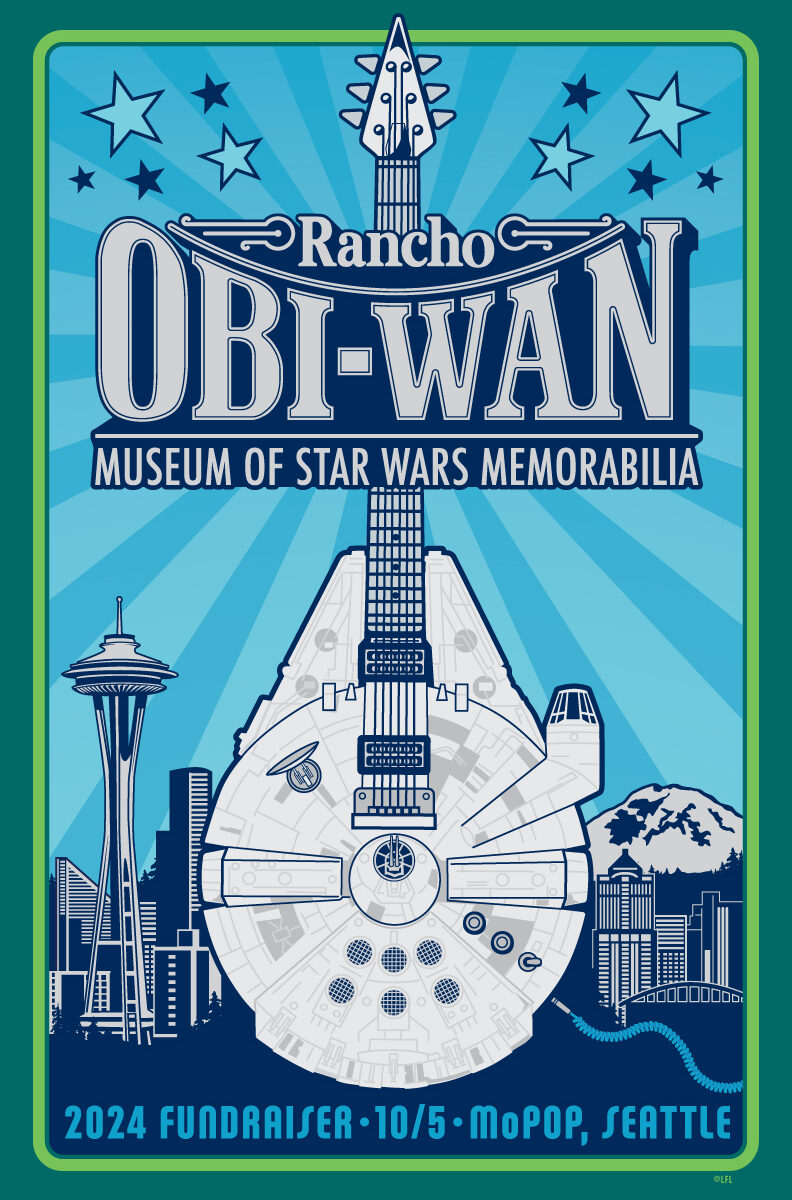
Take a look at a few of the galactic Star Wars auction items for the Rancho Obi-Wan fundraiser Oct. 5th!

Take a look at a few of the galactic Star Wars auction items for the Rancho Obi-Wan fundraiser Oct. 5th in Seattle at The Museum of Pop Culture.  Can’t attend the fundraiser, but want to be able to bid and support Rancho Obi-Wan? We’re excited to now offer absentee bidder privileges for event auction items with ANY Patronage donation!

Live and silent auction items added daily including a custom Star Wars guitar, art pieces, rare memorabilia, vintage collectibles, props and prototypes!


All funds/donations go toward maintaining and preserving the thousands of items in the museum and history of Star Wars. (Insurance, building upkeep etc)- We want to make sure that future generations can enjoy the collection and be inspired as so many have since 1977. Thank you for your support!